




BERLIN PALACE – HUMBOLDT FORUM
Competition Project 2008 collaborator: Michelangelo Zucchini
Executive Project and Realisation management: Franco Stella Humboldt-Forum PG (Franco Stella Architetto, Hilmer & Sattler und Albrecht, Baumanagement Berlin)
Construction 2012-2020
The Berliner Schloss (Berlin Palace), born in 1443 as a residence of the princes of Brandenburg, was transformed at the beginning of the 18th century into the baroque palace of their descendants, who became king of Prussia in 1701, and later, from 1871 to 1918, also German emperors.
Damaged by the bombings of the Second World War, it was finally razed to the ground for ideological reasons in 1950 by the holders of the political power of the GDR. It was the urban-architectural director of the boulevard Unter den Linden – the eighteenth-century triumphal axis, which stretches from the Berlin Palace to the Brandenburger Tor – and of the Museum Island, built during 19 century in its park-garden. With the reconstruction of the Berlin Palace is accompanied the discovery of the meaning of the most important places and buildings of the historical-monumental Centre (Stadtmitte) of Berlin.
Berliner Schloss – Humboldt Forum is the name of the baroque and modern building, constructed between 2012 and 2020. It is intended as a “meeting place for the cultures of the world” dedicated to the Humboldt brothers, with its extra-european Museums of arts and science.
It is a combination of re-constructed Barock and new-constructed Modern parts: this is a singular combination, because normally the Ancient is the original saved from destruction and the Modern is the reconstructed, which does not want to be confused with the original.
The reconstruction, decided by the German Parliament in 2002 and confirmed by the 2008 Competition consists of the stereometry and the façades of the ‘baroque palace’ – namely, the part of the Berlin Palace, redesigned in the late seventeenth/early eighteenth century by Schlüter and Eosander – and of the nineteenth-century dome of Stüler.
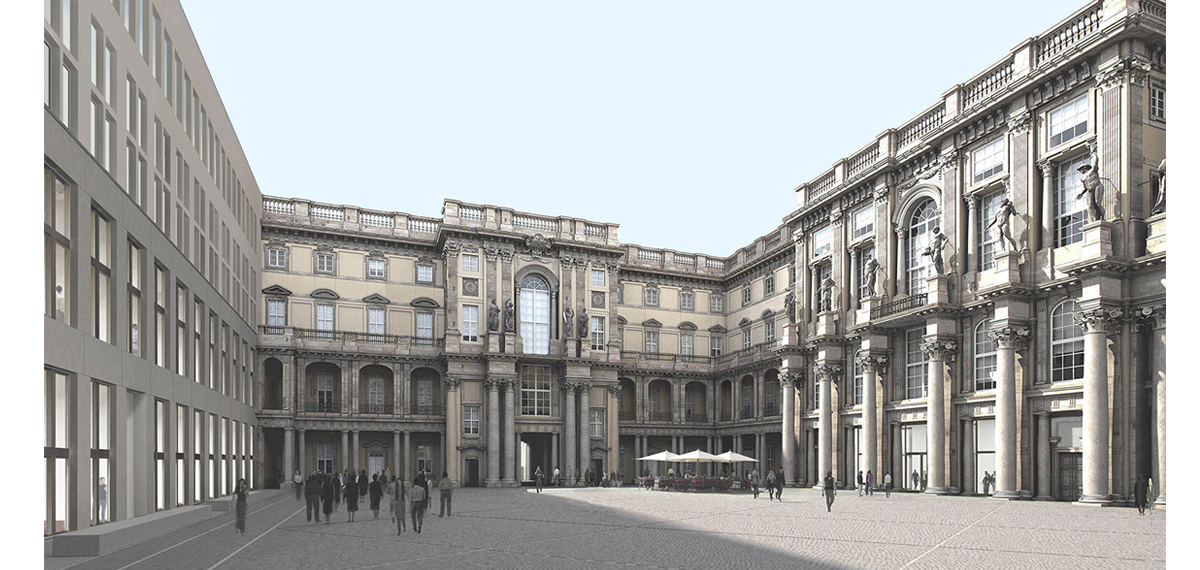
To this ‘mandatory’ reconstruction, my project added the ‘optional’ one of the three baroque portals of the western court (Eosanderhof) and the façade of the dome and its completion with the lantern and cross, so that all the buildings reconstructed in the volume are also in the façade.
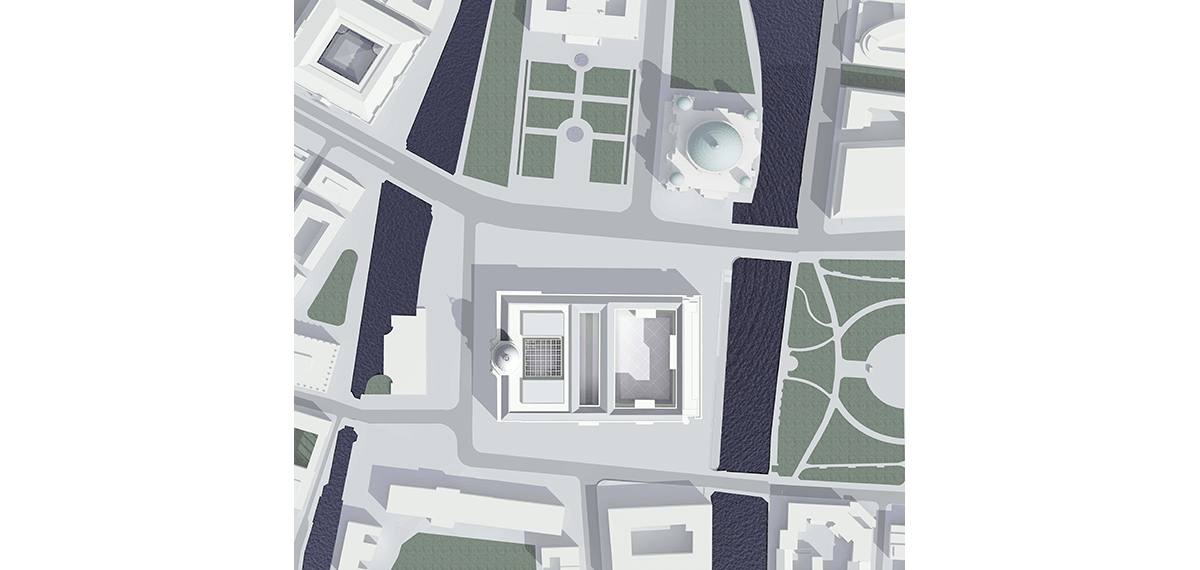
The new construction consists of five buildings: one outside, in the area of the late-Gothic and Renaissance buildings (whose reconstruction was not mandatory), and the others in the area of the earlier major courtyard, the Eosanderhof.
Reconstruction and new construction are complementary parts of a building conveived as a unity: the new construction is not a generic addition, but a fulfillment of what the Berlin Palace was and will be.
Palace, City Gate, Piazza and Theater represent the key ideas/places that inspire the architecture of the New in relation to the reconstructed Old, that is of a ‘timeless’ Modern in relation to an “european Baroque masterpiece” (Schinkel, quote by memory).
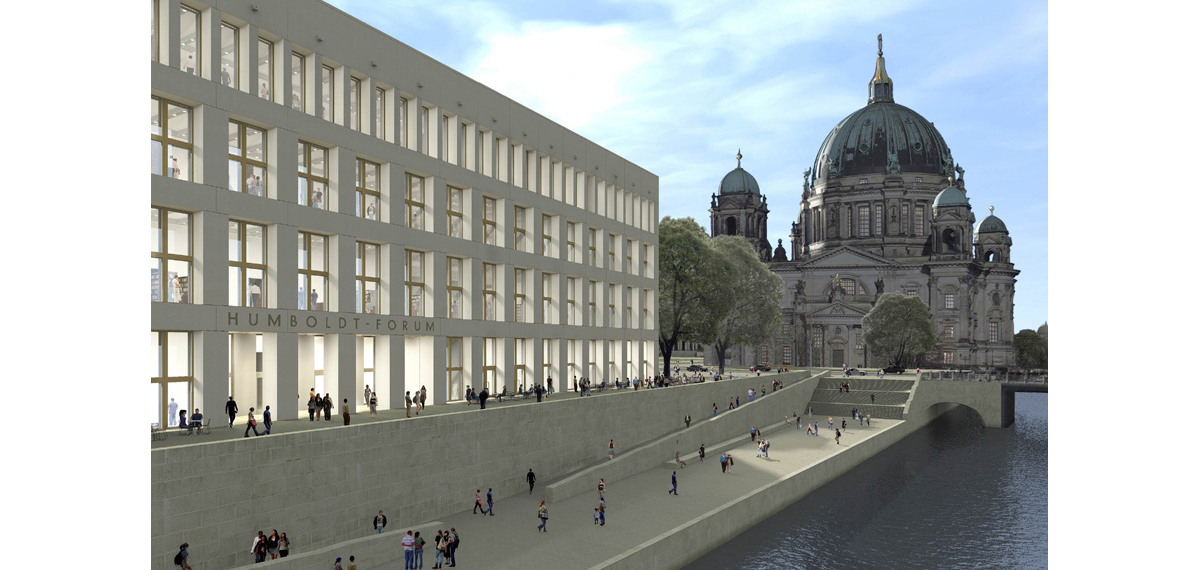
The new external building towards the Spree is conceived as the ‘fourth wing’ of the rebuilt Baroque Palace, following the Schlüter’s original idea of transforming the old Castle into a ‘four-winged palace’.
The four new internal buidings complete the Schlüterhof as a piazza, and conform two new courtyards in relation to the Portals rebuilt as City Gates: the Passage-Schlossforum, whose ‘via colonnata’ (colonnaded street) remind an ancient Forum, and the Humboldt Foyer, which evokes the Theater, with the reconstructed Portal as ‘scenae front’, and the new galleries as ‘spectators loggias’.
As happens in many monuments of the past, the harmony of the whole is not contradicted by the difference in style of its parts.
One could said that the new Berlin Palace is a ‘city in the form of a palace’, through whose portals the external squares are connected with the internal courtyards to create a great public space in the heart of Berlin.